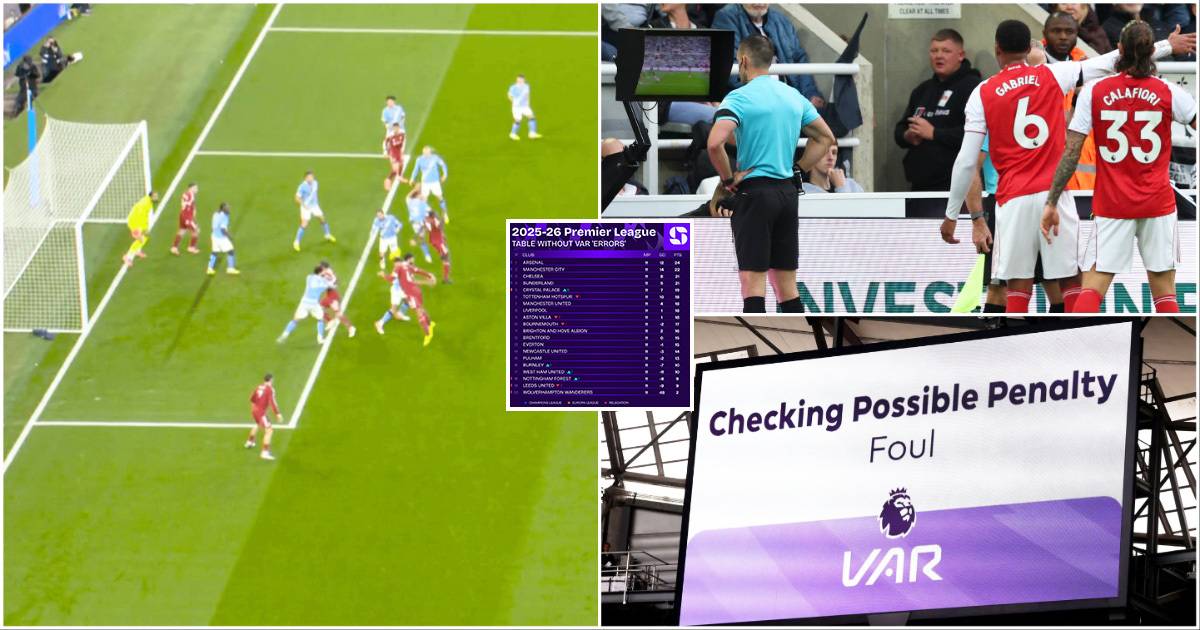
The Unseen Premier League: Unveiling the True Standings Without VAR Errors
The roar of the crowd, the drama of a last-minute winner, the agony of a contentious decision – these are the hallmarks of the Premier League. Yet, since its introduction in the 2019/20 season, the Video Assistant Referee (VAR) has fundamentally altered the landscape of English football, promising to eradicate "clear and obvious errors" but often sparking more debate than resolution. While the technology was welcomed as a tool for fairness, its implementation has consistently raised questions about officiating standards, the flow of the game, and ultimately, the integrity of the Premier League table itself.
Fans across the globe frequently ponder: what would the Premier League table truly look like if every VAR error had been correctly overturned? This isn't just a hypothetical exercise; it's a deep dive into the impact of human judgment (or misjudgment) in conjunction with technology, offering a fascinating epl var comparison that reveals which teams have genuinely benefited and which have been undeniably hard done by. As we delve into the intricate data, we'll explore the real-world implications of these decisions, from relegation battles to European aspirations, and uncover the potential "true standings" of England's top flight.
The Promise vs. The Reality of VAR in the Premier League
VAR was ushered in with the noble intention of enhancing fairness. Its mandate was clear: intervene only for "clear and obvious errors" in four critical areas – goals, penalties, red cards, and mistaken identity. The idea was to arm referees with a safety net, ensuring game-changing mistakes were rectified. However, the journey has been far from smooth.
Despite a dedicated VAR official scrutinising every match, the controversies have persisted, if not intensified. Fans and pundits alike routinely debate the subjectivity inherent in "clear and obvious," the protracted delays, and the often-inconsistent application of the rules. The Professional Game Match Officials Ltd (PGMOL) acknowledges that VAR corrects numerous errors – indeed, over 100 were reportedly corrected in a single recent season – but this official tally often clashes with the collective perception of supporters. What PGMOL deems a successful correction, many fans might perceive as a convoluted process leading to a still-questionable outcome. This disconnect is at the heart of the ongoing debate and fuels the desire to see an alternative Premier League table, one stripped of contentious VAR interventions that seemingly went awry.
The continuous murmurings and periodic apologies from refereeing bodies highlight a crucial point: VAR is a tool operated by humans, and human error, interpretation, and communication remain central to its effectiveness. It's this human element, combined with the technology, that necessitates an in-depth epl var comparison to understand its true influence on the league's competitive balance.
Deconstructing the "True Standings": How an EPL VAR Comparison Works
To construct a Premier League table free from VAR errors, analysts and data providers like Squawka employ a rigorous methodology. This typically involves scrutinising every controversial VAR decision throughout a season and, often through fan polling or expert consensus, determining whether the initial VAR intervention (or lack thereof) was genuinely erroneous. The key steps and considerations include:
- Identifying Controversial Incidents: This goes beyond official PGMOL reviews and often includes decisions that, while perhaps officially upheld, were widely considered incorrect by a significant portion of the football community.
- Reversing the Outcome: If a VAR decision is deemed an error, the hypothetical outcome is reversed. For instance, if a penalty was incorrectly awarded via VAR, it's removed. If a goal was disallowed in error, it's reinstated.
- Simulating Impact: Crucially, these analyses often make assumptions, such as presuming that a penalty, had it been awarded correctly, would have been converted. This allows for a direct calculation of potential point changes.
- Calculating Point Swings: The adjusted outcomes (goals, penalties, red cards) are then used to recalculate the match result, leading to a new points tally for the affected teams.
This systematic approach provides a compelling alternative perspective, allowing us to perform an insightful EPL VAR Comparison: How Errors Impact Premier League Teams. It highlights not only the individual incidents but their cumulative effect, which can significantly alter positions in the league – from the fight for European qualification to the brutal battle against relegation.
It's important to remember that these "alternative tables" are based on a different interpretation of events, often reflecting a fan-centric view rather than official PGMOL rulings. However, their value lies in demonstrating the perception of injustice and the profound psychological and tangible impacts these decisions have on clubs and their supporters.
Who Benefited and Who Suffered? A Glimpse into the Revised Table
When an epl var comparison is made, the results are rarely uniformly distributed. Some teams find their fortunes dramatically shifted, while others remain largely unaffected, underscoring the arbitrary nature of these moments of controversy. Analysis across recent seasons, including hypothetical scenarios for 2024/25 and 2025/26, consistently reveals a mixed bag of winners and losers.
The Unlucky Few: Teams Left Cursing VAR
For some clubs, the data paints a picture of genuine misfortune. Teams battling at the lower end of the table often feel the impact of even a single point swing more acutely than those at the top. For instance, a disallowed equaliser or an incorrectly awarded opposition penalty can be the difference between survival and relegation. Hypothetical models for seasons like 2025/26 have shown teams like Burnley, despite having a VAR mistake go for them once, still losing out on a crucial point that wouldn't have saved them from 19th, but certainly would have offered a glimmer of hope. Similarly, teams like Leeds United in previous analyses have been found to be two points worse off than they should have been, potentially altering their league standing and affecting crucial end-of-season outcomes.
Imagine a scenario where West Ham United, currently hovering around the relegation zone, found themselves level on points with the team above them if VAR errors hadn't occurred. While their position might not change, that single point could be a psychological boost, a stepping stone to safety, or a buffer against the drop on goal difference. These small margins are where the true agony of VAR errors lies for those suffering them.
Unexpected Beneficiaries: Teams Who Dodged a Bullet
Conversely, some teams, perhaps unknowingly, have found themselves in a more favourable position due to VAR errors that went their way or against their opponents. These aren't necessarily deliberate benefits but rather the flip side of the coin – a disallowed opposition goal or an incorrectly awarded penalty that ultimately secured or saved points. While specific examples vary by season, analyses often show that even top-performing clubs might have a net gain of a few points, or have avoided a net loss, thanks to marginal calls that fell their way. It’s a testament to the idea that in a season-long campaign, the pendulum of officiating errors can swing both ways, sometimes favouring those who are already strong. For a detailed breakdown of specific seasonal impacts, you might want to explore the /26 Premier League: Winners & Losers of VAR Errors. What these studies consistently show is that while some teams are resilient enough that VAR errors don't alter their ultimate fate (like Wolverhampton Wanderers, who might remain rock bottom regardless), for many others, their league narrative is undeniably shaped by these technological interventions.
Beyond the Points: The Broader Impact of VAR Errors
While the focus of an epl var comparison is often on points and league positions, the impact of VAR errors reverberates far beyond the numerical standings. These decisions have tangible effects on various aspects of the football ecosystem:
- Fan Disillusionment and Engagement: Consistent controversies breed frustration and a sense of injustice among supporters. The prolonged checks, the overturning of celebrations, and the perceived inconsistency can erode trust in the game's integrity, impacting matchday atmosphere and viewership.
- Managerial Pressure and Job Security: A string of adverse VAR decisions can directly influence match results, potentially leading to lost points, dropped league positions, and ultimately, increased pressure on managers. In the cut-throat world of Premier League football, job security can hinge on fine margins, making VAR's influence a significant factor.
- Financial Implications: The difference between finishing one place higher or lower in the Premier League table can mean millions of pounds in prize money. More dramatically, relegation can lead to a financial catastrophe for clubs, losing out on vast sums of broadcast revenue. VAR errors that contribute to relegation or missing out on European qualification thus have monumental financial consequences.
- Player Psychology and Morale: Players invest immense effort into every game. Having a hard-fought goal disallowed or a crucial decision go against them due to a VAR intervention can be mentally draining, impacting morale and future performance.
For fans, understanding the true standings isn't just about vindication; it's about gaining a more complete picture of the season's narrative. When engaging in discussions about VAR, it's useful to consider the complexity for officials, the pressure they face, and the inherent subjectivity in many situations. While the desire for perfection is understandable, the reality of football officiating, even with technology, remains imperfect. Practical advice for fans is to try and separate the overall team performance from individual VAR decisions, focusing on the broader trends while still acknowledging the impact of key moments.
Conclusion: The Enduring Debate and the Quest for Fairness
The journey of VAR in the Premier League has been a tumultuous one. While its original intent was clear – to enhance fairness and rectify glaring errors – its implementation has introduced new layers of complexity, controversy, and debate. The exercise of examining the "Premier League Table Without VAR Errors" through a comprehensive epl var comparison is more than just a statistical curiosity; it's a powerful way to illustrate the profound impact these decisions have on the league's competitive fabric.
From potential shifts in relegation battles to altered European qualification landscapes, the hypothetical true standings often paint a starkly different picture from the official records. While VAR is unlikely to be abolished anytime soon, the ongoing discussions, the calls for improved communication, and the constant striving for better application reflect a collective desire for a fairer, more transparent game. Ultimately, while technology aims for objective truth, the beautiful game will always be interpreted through human eyes, leaving plenty of room for discussion, disagreement, and the eternal quest for an error-free Premier League.